

Inside the invisible: Dr Bruce Young on the power of nuclear medicine
In a medical field few people understand and even fewer pursue, Dr Bruce Young has found his calling. As a nuclear medicine physician working alongside Life Healthcare, he works at the intersection of radiation, biology and state-of-the-art imaging, helping doctors see what the naked eye cannot.
Nuclear medicine is a small, highly specialised branch of medicine, one that combines physics, chemistry and clinical care in powerful ways. For Dr Young, that blend is part of the appeal. “One of the beautiful things about medicine as a career is that there are so many different avenues.”
From surgery to nuclear medicine
Dr Young didn’t always plan on this path. For years, he believed surgery was his destiny. “I thought I was going to be a surgeon for many years,” he recalls. He trained and worked in surgery during his internship and community service, but along the way he realised something was missing. “I came to understand that I’m not a surgeon. I just didn’t have that passion.” Standing at a crossroads, an unexpected opportunity changed everything. A job post containing a single word – nuclear – caught his attention. “It just sparked an interest and opened a path I hadn’t seen before,” shares Dr Young. Curious, he approached the nuclear medicine department at Wits University’s Charlotte Maxeke Johannesburg Academic Hospital and began spending time there. “I was lucky that they didn’t chase me away,” he laughs. The more he learnt, the more the field revealed itself – and with it, a sense of fascination that quickly turned into conviction.
“It opened up another world. There’s science and radiation and nuclear physics. Nuclear medicine centres around how those interplay with what we know already about biology and anatomy.” Today he has no doubts. “I’m a nuclear medicine physician now – and I’m very happy with the choice I made.”
How nuclear medicine works
To the uninitiated, nuclear medicine can sound daunting. The word nuclear is often associated with ideas far removed from healthcare, a misconception Dr Young encounters regularly. “Our field has the word nuclear in it, but that is just a recipe for people’s projections,” he says. “I have nothing to do with power stations or weapons. I’m a doctor, nothing else,” he assures.
In simple terms, nuclear medicine uses small amounts of radioactive material, known as radiotracers, attached to a molecule the body already uses, such as glucose, to diagnose and treat disease. Unlike traditional X-rays or CT scans, where radiation passes through the body from the outside, nuclear medicine works from within. In most cases, the radiotracer is injected into the patient, then travels to specific organs and follows normal biological processes.
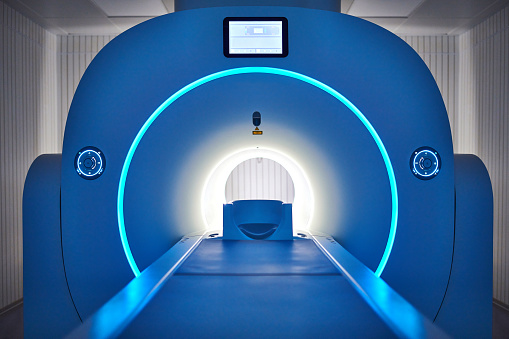
“We combine a small amount of radiation with a substance the body already uses and inject it into the bloodstream,” Dr Young explains. “As that radiation is emitted, we capture images using advanced technology.” Highly sensitive scanners such as PET-CT detect these signals and send them to a computer, which reconstructs detailed images showing where the tissue is located and how it is behaving. Areas that use more energy – such as cancer cells or inflamed tissue – appear more prominent on the scan.
Because nuclear medicine images are based on function rather that structure, they can reveal disease that other imaging methods may miss. A tumour, for example, may look unchanged on a CT scan, but combine it with a PET image and you will also see whether it is metabolically active or responding to treatment.
Designed around patient safety
Radiation is often a concern for patients and families. In nuclear medicine, doses are carefully calculated, tightly regulated and kept as low as possible, with many radiotracers leaving the body quickly. Global authorities such as the World Health Organization (WHO) and the International Atomic Energy Agency (IAEA) confirm these exposures are monitored and safe. “Radiation is not used casually,” says Dr Young. “It is measured, controlled and respected.”
A growing field in South Africa
Nuclear medicine may be a niche profession, but it is evolving rapidly, particularly in PET-CT imaging and targeted therapies. “There’s probably one to three graduates a year coming into the specialty,” Dr Young notes. “South Africa’s tertiary institutions offer rigorous postgraduate training in nuclear medicine for doctors, physicists and radiographers. This is strictly regulated by the Health Professions Council of South Africa (HPCSA) and the National Department of Health to meet international standards. South Africa currently has around 23 PET-CT scanners across state and private facilities – far fewer per capita than peer nations. As demand grows, more facilities are making units available, including the recently launched nuclear medicine unit at Life Vincent Pallotti Hospital and the Group’s two additional scanners planned for KwaZulu-Natal later this year. The growth of PET-CT units, particularly in South Africa for lymphoma, prostate, lung and colorectal cancers, including some breast cancers, head and neck cancers and melanomas, represents what he calls a “step change” in patient access to advanced diagnostics and care.
Insight that guides every step
While much of his day involves analysing scans – “one man and his computer screen,” as he jokingly describes it – Dr Young’s work is far from solitary. “I find it quite collaborative,” he says. “I’m always asking questions of my colleagues: ‘Could it mean this? Could it mean that?’” Beyond diagnostics, he also delivers targeted cancer therapies. These moments can be deeply impactful. “If you can make a difference by giving a patient another one, two, three, four, five years of life with the treatments that you’ve provided, that’s a very powerful and meaningful experience.”
Looking to the future
What excites Dr Young most about the future is the scientific frontier. The potential combinations of radioactive molecules and biological targets are vast. “There’s an infinite space of what that could be,” he reflects. “They’re always developing new molecules that you’re either going to take pictures with or treat something with – but progress in medicine takes patience. There’s extensive research and a very co-ordinated vetting process. You’ve got to be patient.”
Letting curiosity lead your path
For those considering pursuing a career in nuclear medicine, his advice is simple: “If you have an interest in it, talk to someone in the field.” And perhaps most importantly: stay curious. “The more interested and curious you are, the better insights you’ll be able to give your patients.” In a world obsessed with what is visible and immediate, Dr Young has built a career illuminating the invisible, quietly, precisely – and with profound impact.
For more about how PET-CT is revolutionising cancer care, visit: https://www.lifehealthcare.co.za/news-and-info-hub/life-diagnostics/did-you-know-advancements-in-nuclear-medicine-and-pet-ct-are-transforming-cancer-treatment-in-south-africa/